

Full 27 page text HERE.
Ayn Rand’s essay “The Comprachicos” (published in 1970 in The New Left: The Anti-Industrial Revolution, later retitled in some editions as part of Return of the Primitive) is a fierce critique of modern progressive education. Rand draws a powerful and disturbing metaphor from Victor Hugo’s novel The Man Who Laughs (also known as L’Homme qui rit).
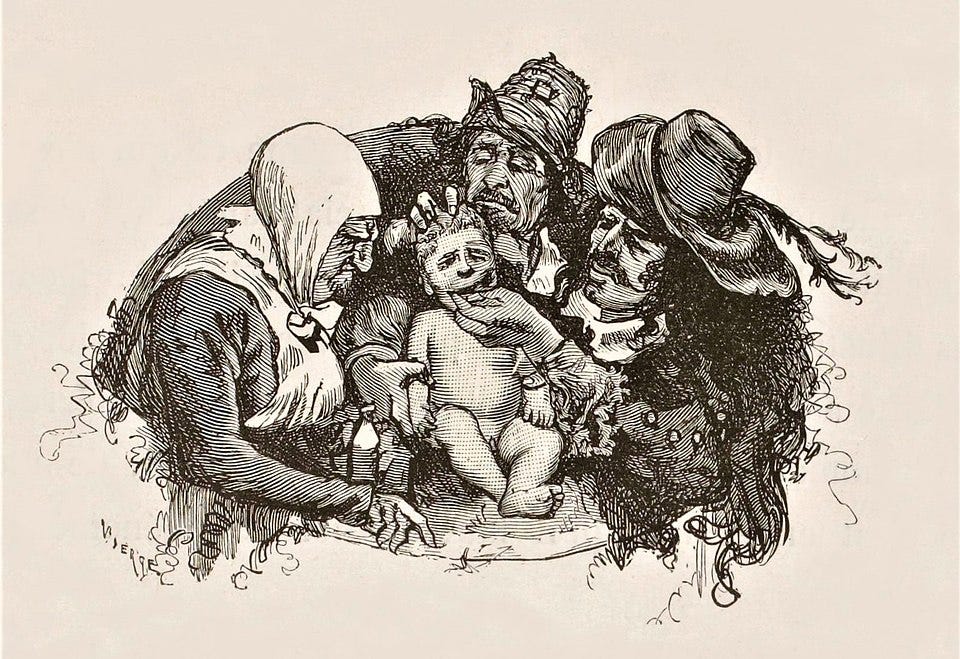
The title refers to the “comprachicos” (Spanish for “child-buyers”), a 17th-century nomadic group described by Hugo who bought or acquired young children and deliberately deformed them through brutal physical methods (e.g., stunting growth, dislocating joints, mutilating faces with burns, bindings, or incisions). The goal was to create permanent “monsters,” freaks, dwarfs, or grotesques for entertainment—court jesters, circus attractions, or street performers. These children were mutilated early so the deformities became permanent and natural-looking, erasing any memory of the trauma. Rand quotes Hugo extensively to emphasize the cruelty: deformity was seen as more useful than death for political control and amusement, as a living, flesh-based “mask” could never be removed.
“Comprachicos of the Mind” Rand argues that contemporary educators (especially those influenced by progressive education theories dominant in the mid-20th century) are the modern equivalents—the “comprachicos of the mind.” They do not physically deform children but intellectually and psychologically cripple them in a subtler, more insidious way:
They operate openly and with societal approval (children are “delivered” to schools).
They use no knives or irons, yet achieve the same end: stunting the child’s cognitive and emotional development.
The result is a generation of intellectual “monsters”—adults who are helpless, irrational, emotionally stunted, unable to think independently, disconnected from reality, and prone to whim, conformity, and collectivism.
Key Criticisms of Progressive Education:
Rand targets several specific practices and philosophies she sees as destructive:
Rejection of structured, conceptual learning in favor of anti-conceptual, concrete-bound, or “look-say” methods (e.g., in reading instruction).
Emphasis on socialization, group conformity (”the pack”), emotionalism, and anti-reason over individual rational thought.
Suppression of the child’s independent mind, replacing it with whim-worship, relativism, and tribalism.
The process begins early and is inexplicit: children absorb anti-reason premises emotionally and subconsciously, leaving them unaware of their own mutilation (just as Hugo’s victims forgot the surgery).
She describes how this produces adults who are:
Incapable of grasping objective reality.
Dependent on others’ approval.
Prone to irrationality, mysticism, or statism.
Alienated from their own minds and values.
Broader ImplicationsThe essay ties this educational malpractice to the cultural and political decline Rand saw in the 1960s–70s (student rebellions, anti-intellectualism, the New Left). She views it as a deliberate (or at least functionally equivalent) attack on the human mind, far worse than physical deformity because it destroys the faculty of reason itself—the tool of human survival and flourishing.In Rand’s view, true education should foster rational, conceptual thinking and independence, not conformity or emotional “adjustment.” The comprachicos of the mind produce twisted souls who can be more easily controlled or manipulated by collectivist ideologies.This essay is one of Rand’s most passionate and emotionally charged pieces on education, blending literary analysis, epistemology, and moral outrage. It remains influential among Objectivists as a warning about the long-term damage of anti-rational teaching methods.
If Ayn Rand’s essay doesn’t describe the current state precisely, I’m not sure what does.
“There were educators. They took a man and turned him into a miscarriage; they took a face and made a muzzle. They stunted growth; they mangled features. This artificial production of teratological cases had its own rules. It was a whole science. Imagine an inverted orthopedics. Where God had put a straight glance, this art put a squint. Where God had put harmony, they put deformity. Where God had put perfection, they brought back a botched attempt. And, in the eyes of connoisseurs, it is the botched that was perfect …”
BIO: Dr. Sean M. Brooks is the host of the podcast American Education FM and the author of several books including; The Unmasking of American Schools: The Sanctioned Abuse of Americas Teachers and Students. He’s also on Gab, X, Truth, Bitchute, Rumble and everywhere audio podcasts can be heard.
I forgot about this work - read it years ago - she nailed it. thanks for refreshing my memory
Excellent post! Great read. Thank you!